St Augustine, Florida – The oldest city in the United
States.
The City of St Augustine, founded by the Spanish in 1565,
claims to be the oldest continuously occupied city in the continental United
States. It is located on Florida’s Atlantic coast in the northeastern part of
the state. We visited this interesting city with our young children many years
ago, but at the time there was so much else to see that we missed a lot. In
November of 2021, we made another visit on our own.
Such an old city is steeped in rich history. For example, at
different times it has been governed and fought over by the Spanish, the
British and the Americans. It was the capital of Florida in the early 19th
century before Tallahassee became the state capital. With so much to see, it's
best to plan ahead and determine what sights you particularly want to visit,
especially if you are only going to be there for just one day, like we were. To
see everything would probably take two days. We got hold of a tour map from
TrolleyTours.com which is online and chose the places we wanted to see in
advance.
There are 22 places listed on this map. The trolley can be a fun way to see the
city because you don't have to worry about parking which is a challenge at some
of the venues. Tickets cost $32.59 per person, if you pay in advance, otherwise
they are $40.70. They do offer package deals that include complimentary hotel
shuttle services.
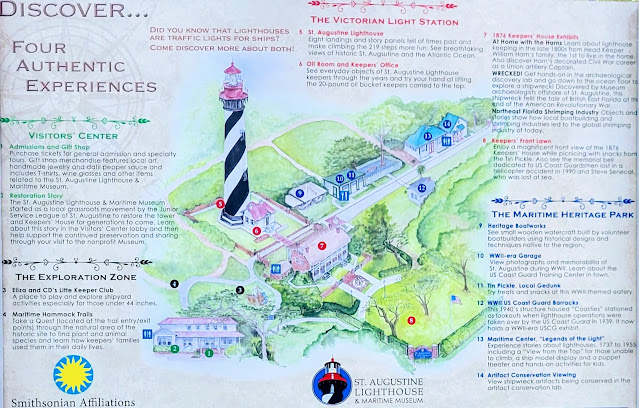
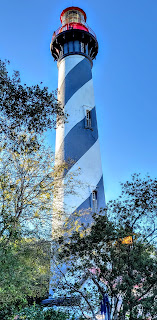
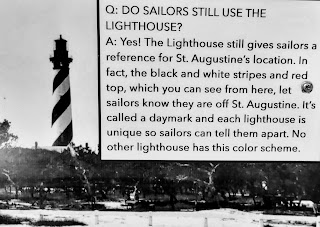
THE LIGHTHOUSE was built in the late 19th century and one can climb to the top from where it is said that spectacular 25-mile views across the city and ocean can be enjoyed.There was no elevator, so this involves climbing 219 stairs, which equals 14 stories. Your octogenarian and septuagenarian correspondents declined to climb on account of old age and thus missed out on the views. Yet the lighthouse is apparently haunted, so this reluctance even to attempt the climb probably avoided increasing the ghost population. The lighthouse was used to look for Nazi submarines lurking off the Florida coast during the Second World War. For further information, www.Staugustinelighthouse.org .
Map of St. Augustine Lighthouse and Maritime Museum Park
St. Augustine Lighthouse
Lighthouse use today
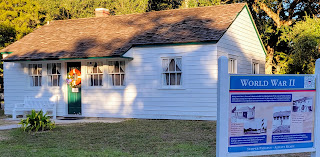
WWII Coast Guard Barracks
1876 Keeper's House Exhibits
L- Maritime Center R- Artifact Conservation
Old Senator Tree in hotel parking lot
Old Senator Tree
THE OLD SENATOR is not a politician. It is instead a live
oak tree claiming to be over 600 years old. That dates it even before the
arrival of Spanish explorer Ponce de Leon in 1513.If only this tree could talk, what stories it
could tell! These days it stands in a
hotel parking lot.It reminds one of the
Cotton Tree in the middle of Freetown,
Sierra Leone as described in another post on this website.
PONCE DE LEON’S FOUNTAIN OF YOUTH is a 15-acre waterfront archaeological
park and is probably Florida’s oldest attraction. Guest books date back to 1868.
The park is located next to The Old Senator. It is said that, on his 1513
expedition to Florida, Ponce de Leon was searching here for the Fountain of
Youth, a mythical spring supposed to restore the youth of those who drink it or
bathe in it.There is no evidence to
support the story that this is what Ponce de Leon was looking for.If he was, it seems that he didn’t find it, because
Florida now hosts more old people than anywhere else. Thus, it appears that the
Fountain of Youth has yet to be found even though the park does contain a
spring. One can learn more about it and about much else at www.fountainofyouthflorida.com
.
Gonzalez-Alvarez House
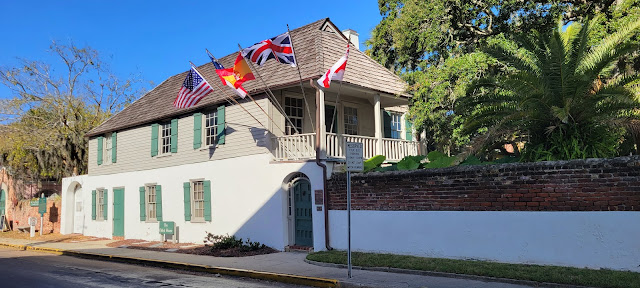
THE OLDEST HOUSE. As one might expect, the oldest city in
the country also contains the oldest house. It is called the Gonzalez-Alvarez House, and
is located on 14 St Francis Street, St Augustine, and was built between 1702
and 1727. As Bob was quick to point out, this would not be considered old in
England, the country of his birth. He also suspects that it may be pre-dated by
houses in New England. Surely those Pilgrims, facing freezing Massachusetts winters
in the 1600s would have built houses with thick walls that would have stood the
test of time. Nevertheless, this house in St Augustine maintains a very credible
and detailed website at www.oldesthouse.org
and confidently proclaims its great antiquity.
Castillo De San Marcos
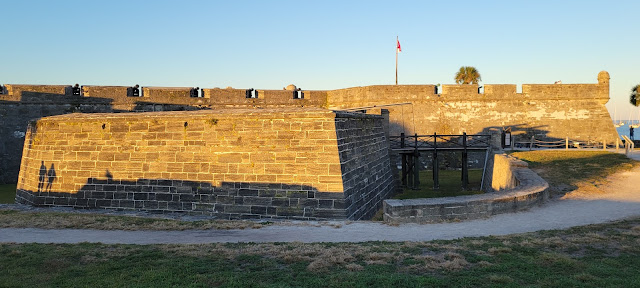
CASTILLO DE SAN MARCOS. It is the oldest stone-built fort in
the continental United States and is sited right on the waterfront.
Unfortunately, we got there late in the day when it was closing. Sadly, we've
never seen the inside, but Pat got lots of pictures of the outside. The Spanish
governor began its construction in 1668, after its wooden predecessor and
indeed the rest of the city of St Augustine was burned to the ground by English
pirates. The new stone fort proved to be impregnable. In the centuries that
followed its construction it was never taken by force, while control of the
fort often peacefully changed hands by treaty or negotiation between opposing
states. Even General James Oglethorpe, founder of neighboring Georgia about
whom much has been written elsewhere on this website, made an unsuccessful
attempt to capture the fort. Yet all good things come to an end. Early in the
20th century, the US War Department had no further use for the fort and it was
de-commissioned. It has since been declared a National Monument.
Spanish Military Hospital Museum
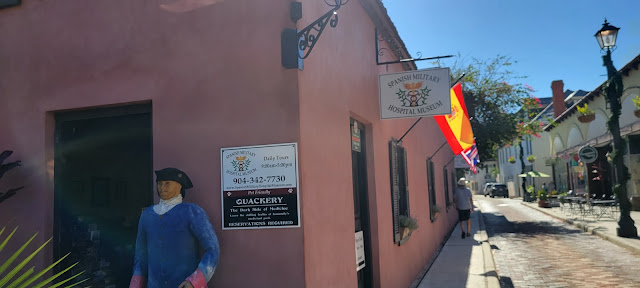
THE SPANISH MILITARY HOSPITAL MUSEUM is hard to find because
it is in the center of the historic district, where narrow streets and a
one-way traffic system keep one moving in never-ending circles. Access is finally
gained by driving through a picturesque Spanish arch. The architecture is
unusual, and the museum gives one insight into the surgical practices of over
two centuries ago.
Finally, if visiting all these attractions and many more have
left you hungry and exhausted, a visit to the nearby AMICI’S ITALIAN RESTAURANT
located at 1915 A1A South in St. Augustine is called for. Owned and operated by a husband- and-wife team who were
unlucky enough to buy it in March 2020, just a week before it was closed by the
Covid pandemic. We highly recommend Amici's and very much appreciated generous
portions, excellent cuisine, quality service and reasonable prices. All of these
were much needed after touring the oldest city in America.
It was a beautiful sunny day as we set off on our honeymoon from our house in Harley Street in Marylebone, London on Saturday September 13th, 1980. We made it to the English coastal town of Dover around dinner time. Luckily, we found a charming hotel called the Spinning Wheel and spent the night. We hadn't booked a single hotel in advance and took our chances each day. For most of the trip, we did pretty well and only once did we end up in less that ideal accommodations. Not bad for a three week road trip!
The next morning, after a leisurely breakfast at a picturesque cafe in Dover with a magnificent view of the ocean, we found ourselves in a long line of cars and trucks to catch the ferry that would land us in Belgium, where we began our sojourn across Europe. It was smooth sailing as we pulled away from the white cliffs of Dover on the car ferry, and studied the maps to determine the best route to our ultimate destination, Venice, Italy.
Arriving in Brussels in the late afternoon, we drove around the city to see the sights and found the Hilton Hotel that overlooked the Parliament building. Although Belgium is beautiful, we had no time for sightseeing the next morning and pushed on to Baden Baden, Germany.
Driving our new Volvo, we listened to music suitably romantic for honeymooners. Our favorite CD was that of Anne Murray, a Canadian singer, that included her song "SnowBird", which was our favorite.
Hotel Haus Reichert in Baden Baden, Germany
Thanks to the amazing highway system in Germany, where speeding along at 80 miles per hour is your only option if you want to survive, we made it to Baden Baden by dinner time. Not having booked ahead, we were fortunate to find a lovely place in the heart of town, the Hotel Haus Reichart. This quaint family owned establishment was the perfect place for us. The room was cozy and comfortable and the staff were friendly and very helpful in guiding us to the best nearby restaurant.
Our next stop was the picturesque town of Oberammergau, Germany, a picturesque little village located in the
Bavarian Alps in southern Germany, just to the north of the Austrian border. In
1632, the area was hit by an outbreak of bubonic plague, so the village
promised that, every ten years, it would perform a play about Jesus if only God
would protect them from the plague. It is recorded that the death rate then
dropped dramatically. Oberammergau has since kept its promise. Its Passion Play
was first performed in 1634 and it continues to be performed in every year with
a zero at its end. In September 2020, it was performed for the 42nd time.
Photo is a picture of the cover of the book we bought about the Passion play
The play runs for seven hours and takes over 2000 people to put it
on. In order to participate, one must be
a resident of Oberammergau by birth. What is remarkable is that the entire population of the village is only
5,000, which means that every family is involved in the production while
continuing its normal life. Yet, when we saw the young man playing the part of
Jesus riding his bicycle down the main street of the village, it seemed almost
blasphemous.
The village is also famous for its woodcarvings and its painted
houses. We bought a charming carved statue of the Blessed Mother Mary, which we still have (Photo on the left.) Every house has a religious painting on one wall. The paintings are beautiful as if done by a master painter. Combined with the overflowing flower baskets, the village is one of the most picturesque villages in Germany.
Blessed Mother
Oberammgerau
The next day we set off for one of Bob's favorite places, a ski resort town in Saalbach, Austria. He had many fond memories of going there in his twenties with his skiing buddies and couldn't wait for me to see it. Again, thanks to the super highway system, we made it to the Hotel Saalbacher Hof in time for dinner.
Hotel Saalbacher Hof Saalbach, Austria
The hotel offered a fun and entertaining meal which was highlighted by music and men in costume performing a dance called schuplattling. It is a type of Austrian folk dancing where the dancers stomp, clap and strike the soles of their shoes (Schuhe), thighs and knees with their hands held flat (platt).
Schuheplatting performance
They picked Bob out from the crowd and tried to teach him how to do it. It was the funniest thing I had ever seen Bob do, especially since he had several beers with dinner, which helped to instill in him a false sense of confidence as a novice schuplattler. He gave it his best shot and the guys were all very nice to him. The crowd even gave him a round of applause for his efforts. After dinner and all the dancing, we made our way to the indoor spa and hot tub so Bob could rest his weary bones and get ready for trekking into the mountains the next day.
The town of Saalbach sits in the shadow of the Gross Glochner, the highest mountain in Austria and the highest in the Alps east of the Brenner Pass. Like most ski resort towns, the ski lift runs all year long, taking people up into the mountains with well marked walking trails leading down. We were not really prepared for hiking in the mountains and didn't have the proper gear, but we went anyway.
Gross Glochner
Looking back on it, we must have looked quite out of place, with Pat in her chic French pantsuit and Bob wearing his favorite shirt and trousers. Making our way down the mountain, we were frequently winded and out of breath, taking frequent rests at many of the benches along the way. Perhaps the most vivid memory was watching all the senior citizens in their lederhosen, passing us by, like cars in the fast lane speeding past the slower cars. They were obviously in better physical condition than us. At that time, Pat was 30 and Bob was 43 and we certainly couldn't keep up with those spry people in their 70's and 80's.
Hotel Londra Palace
After spending two nights in Saalbach, we drove over the Alps and down onto the plains of northern Italy. We
arrived in Venice at the Hotel Londra at 4:00pm, exactly as planned. We set out immediately to inspect the famous old city,
travelling its canals being serenaded by singing gondoliers.
Walking in St Marks Square, we admired The Doge's Palace and quenched our thirst in
Harry's Bar. Yet we hated Venice. Grand as its buildings undoubtedly were, the
place was crowded with too many tourists and very overpriced. Even the water in
the canals looked dirty; not very romantic at all and certainly no place to spend
one's honeymoon. Our solution to the problem was quickly to leave Venice and to
drive all the way across northern Italy from east to west, finally arriving at
the little Italian frontier town of Ventimiglia on the French border.
Trailer for the film "The Day of the Jackal"
The town
looked familiar because Bob had seen it depicted in "The Day of the Jackal", a recently released film
based on the novel of the same name by Frederick Forsyth, one of Bob's favorite
authors. It was the border point through
which the Jackal smuggled into France the weapon with which he intended to
assassinate President De Gaulle. Unarmed
as we were, we passed smoothly through the border point and into France. We
were finally on La Cote d'Azur.
We never planned to visit La Cote d'Azur during our honeymoon, as our original plan was to spend at least 5 days in Venice, Italy. The picturesque French coast is little more than 125 miles in length. It's beautiful and offers magnificent beaches, a deep blue sea, and plenty of sun. Many of the rich and famous already live there or visit frequently.
Located in the southeastern corner of France, it's known by the locals as La Cote d'Azur, in recognition of the azure color of the adjacent Mediterranean Sea. The English call it either the French Riviera or simply the South of France. It was always included in the Grand Tour of Europe, undertaken by every young English aristocrat in the 19th century.
Beginning at the French/Italian border, we drove westward into France, along fine boulevards with the sea on our left and some of the world's finest hotels and restaurants on the right. Drivers should guard against the distraction provided by the spectacle of many topless lady windsurfers and water skiers bobbing about on the water.
Carlton Hotel in Cannes
During the rest of our honeymoon, we based ourselves at the
Carlton Hotel in the town of Cannes, world famous because of its annual film
festival. The hotel faces the sea and guests can simply walk across a boulevard to access its private beach
and be served magnificent food and drinks all day by well groomed waiters. Many years later, in 2013, the Carlton was the scene of the world's largest jewel heist. The lone robber, who was never caught, escaped with jewels worth $136 million.
We hired a boat with a driver to take Pat water
skiing. However, it had been 17 years since she last skied and she had difficulty getting up on the skis. Once that was finally accomplished, the driver of the boat kept shouting at her to "bend zee knees". Needless to say, the next day Pat was sore all over from her exertions but she had a great time skiing in the Mediterranean.
Mixed flowers in the field in Grasse
Up in the hills, only ten miles behind Cannes, lies the town of Grasse, known as the center
of the French perfume industry. As we drove through the hills with our car windows down, the scent of an immense variety of fragrances permeated the air from the many locally grown flowers. It was a truly remarkable experience.
Comte de Grasse
This area also produced the legendary Comte de Grasse. He was the French admiral who
greatly aided George Washington in his victory over the British at Yorktown in
1781, which ended the American Revolutionary War. You can read more about this on our website under the title "Cape Henry, Virginia - The Battle of the Capes".
St. Tropez
Although Cannes was our base, there were many other places for
us to visit on La Cote d'Azur, which ends in the west near the fishing village
of St Tropez, hometown of Brigitte Bardot.
Brigitte Bardot
In the 1950s, Bardot starred in a series of films which made her an
international superstar. St Tropez used the publicity to promote the area, turning it into a fashionable tourist resort. Bardot has lived her whole life in St Tropez and is now in her
mid-eighties. Meanwhile, St Tropez, in 2017, showed its
gratitude by erecting a statue of her in front of the cinema.
Brigitte Bardot bronze statue
Of all the other places we visited on La Cote d'Azur, by far the largest was the city of Nice. Conspicuous on its seafront is the luxurious Hotel Negresco, whose great chandelier was originally intended for the Czar of Russia. Alas the Czar came to a sticky end in the 1917 Russian revolution and he was unable to take delivery of his chandelier, which has therefore spent the last century hanging in the Negresco. The famous hotel was also featured in the movie The Day of the Jackal.
Hotel Negresco in Nice
Czar of Russia Chandelier in Hotel Negresco
La Cote d'Azur is home to another country as well as France.
Apart from the Vatican, it's the
smallest country in the world with less than one square mile of land area and
only a couple of miles of coastline. It lies between Cannes and the Italian border
and is the Principality of Monaco, the capital of which is the town of Monte
Carlo.
Grimaldi Royal Palace in Monaco
The Royal palace of Monaco, perched high on a rocky promontory, began life as a fortress in 1191 to combat piracy. Granted the land by German Emperor Frederick I, Monaco has been ruled by the Grimaldi family since 1297. They were one of the aristocratic families of Genoa who were originally traders and suppliers of money, ships and soldiers to many European monarchies.
Over the centuries, the Grimaldis have fought several wars to keep their land and sovereignty. In 1793, on the heals of the French Revolution, the Grimaldi royal family was driven from their home and the palace fell into disrepair, at one time being designated as a Poorhouse.
In May of 1814, under the protection of France, the Grimaldi royal family once again ruled Monaco. Renowned as collectors of all things beautiful, which included 700 works of art by Old Masters such as Raphael, Titian, Michelangelo and others, they continued their centuries old tradition to fill the palace walls and galleries with all things beautiful.
Monte Carlo Casino
In 1854, a plan was hatched to generate income and save the royal family from bankruptcy. Princess Caroline, the brilliant business-minded spouse of Prince Florestan, came up with the idea of creating a casino and turning the area into a highly desirable destination for the wealthy elites of Europe to spend their money. Under Princess Caroline's direction, the Monte Carlo Casino was created. Original investors included the Bishop of Monaco and the future Pope Leo XIII. With the Church's money and blessing, Monaco became the glamourous destination of the rich and famous.
In the 1890s, a song very popular in London music halls (vaudeville theaters) was "The man who broke the Bank at Monte Carlo." The song was inspired by the success of a British gambler who won too much money at this casino. A film of the same name, which depicted the story of how he did it, was released in the 1930s.
We did not enter the casino and try to emulate the formidable gambler. Instead, we dined in a restaurant atop a building that overlooked the harbor, with a bird's eye view of all the pricey yachts moored there. As we strolled along the harbor, we spotted a US Navy ship, the USS Discovery. It was a public relations type of vessel used to promote goodwill for the USA around the world. At the time, Pat was on active duty in the US Navy, and we stopped to see the ship. Sadly, it was getting late we didn't get to go onboard, but it was fun to see the ship up close and to chat briefly with some of the crew.
In 1956, Prince Rainier III married the stunning American actress Grace Kelly. The fairytale wedding drew thousands of tourists to the tiny principality. Tourism is still a mainstay of the economy. Sadly, Princess Grace died in a
road accident in September 1982 while being driven in a car by her daughter Stephanie. Prince Rainier III was still head of state at the time of our visit. He died in 2005 and was succeeded by his son, Albert II.
For most of his life, the great author Somerset Maugham lived on La Cote d'Azur. He called Monte Carlo "a sunny place for shady people". That's because so many of its very wealthy residents are there simply to avoid taxes in their own countries. There is no income tax in Monaco and low business taxes.
We arrived on La Cote d'Azur by accident and have never
returned. Yet the memorable part that it
played on our honeymoon is something that we have remembered all our lives.
On our final leg of our trip, we drove to Paris from Cannes. Before we were married, we did a 9-week Novena of the Miraculous Medal. We each prayed for a specific miracle and both were granted by the time we got back home.
Miraculous Medal
The Miraculous Medal is a fascinating story about a young French girl named Catherine Laboure. She became a nun and lived in a convent in Paris, where she experienced several apparitions of the Blessed Mother Mary. The young nun was told to get the Miraculous Medal made and gave specific instructions about how it should look. This is where the novena was created.
Catherine Laboure's body in glass case
Catherine Laboure's body is lying in a glass coffin in the front of the chapel. Her body has never decomposed and lies "uncorrupted" and on display.
Click on video link below showing the Chapelle de la rue du bac.
Our goal was to go to mass at the Chapel of the Miraculous Medal (see video above) and to give thanks for our many blessings and the miracles granted to us. Before leaving our hotel, Pat had a premonition that they would lose the camera and not to take it. Bob insisted on taking it along. The camera was in a plastic bag with all the rolls of film from their entire 3-week honeymoon. Bob carried the bag and put it in the back window area behind the seats in the cab. They got out of the cab at the chapel and watched the cab pull away with the camera bag in the back window. It was lost forever and never recovered. We often wondered if someone ever found it and developed the film. At least we still have our memories of the best honeymoon ever!
There are some very attractive destinations to visit in Portugal, so let us begin by naming four of them. There is Estoril, a coastal resort near Lisbon. Estoril was a popular destination for royalty who had been forcibly retired by their subjects. If former kings and queens decided to spend their exile in Estoril, it must have had something going for it.
Then there is Oporto in the north of Portugal, the city that port wine comes from. There are dozens of different companies in Oporto producing port wine, and even more opportunities to taste and compare their various blends.
Then there is the university city of Coimbra, midway between Lisbon and Oporto. Founded in 1290, at about the same time as Oxford and Cambridge, the university dominates the area. It has filled the city with medieval monuments and writers and artists, not to mention tens of thousands of students.
Finally, there is Lisbon itself, the capital of Portugal, sitting on the banks of the Tagus just where that river flows into the Atlantic. One of the largest cities in Europe at the time, it was almost entirely destroyed by earthquake in 1755 and 35,000 people were killed. Although there was a record of prior earthquakes in the area, what seems to have hit Lisbon then was a tsunami. At the time of this destruction, huge waves were hitting the coast as far south as Morocco and as far north as England and Ireland. Yet, Lisbon was the center of the devastation. It has since been beautifully rebuilt.
Christo-Rei in Lisbon
What catches the eye on visiting Lisbon is the Christo-Rei statue, facing Lisbon on the opposite bank of the river. It was built to thank God for the neutrality of Portugal during the Second World War and is based on a similar statue, which overlooks Rio de Janeiro in Brazil. The statue is a figure of Christ, with outstretched arms, rising to a height of several hundred feet and appearing to embrace Lisbon.
With such glorious sights to see in Portugal, I hesitate to tell you where I always finished up. Certainly I did visit all the fine cities mentioned above but, on my trips to Portugal every August in the late 1960s, I would always head for the Algarve.
Click on video below for more information on the Algarve.
The Algarve is the southern region of Portugal, the coast of which faces across to Morocco. The name derives from the Arabic words, Al Gharb, which means “the west”. The area was conquered by the Moors in 711 AD and remained under their occupation for the next 500 years.
Cape St. Vincent
The coast of the Algarve runs for about 100 miles in an east-west direction. Then it makes a right angled turn at Cape St Vincent and continues for 35 miles to the north. Cape St Vincent is famous for many reasons. It is the extreme south west tip of Europe. It was the burial place for many centuries of the Christian martyr, St Vincent. It has a tall lighthouse visible for many miles. It was the scene of two major naval victories by the British over the Spanish in 1780 and in 1797. In the first battle, the British fleet was on its way to end a siege of Gibraltar by the Spanish. In the second battle, Nelson participated.
Prince Henry the Navigator
Long before those battles however, Prince Henry the Navigator was based at Cape St Vincent. In 1419, he built himself a fine villa there and had Daddy (King John I of Portugal) appoint him Governor of the Algarve. Now I have always admired how explorers of that time, based in Portugal, undertook risky voyages to open up the sea routes of the world. There were Magellan and Columbus and Vasco da Gama and many others. I always believed that Prince Henry the Navigator was part of that brave tradition. In fact, he never went to sea. He never even left Portugal. He arranged for others to take the risks and the hardships, while he kept the comfort and the glory. Even though, he was a good man who led a long and happy life, am I alone in feeling a little disappointed by Henry?
Click on video below for more information on Prince Henry and his accomplishments.
Fishing boats in Monte Gordo
The south facing coast of the Algarve begins in the east at the Spanish border which is marked by the River Guadiana. The Portuguese border town on the banks of that river is Vila Real de Santo Antonio, next to which was a little fishing village called Monte Gordo. I say “was”, because in forty years it has much changed. It is now a bustling resort, but it was Monte Gordo that I would visit every August. In that area, the land is flat and the beaches are wide and sandy. Thanks to the waters of the nearby River Guadiana, the sea is warm and it’s the sunniest place in Europe. Moving along the coast to the west, the beaches become far rockier and much more fashionable. One passes Olhao, Faro (with its international airport), Albufeira, Portimao, Lagos, Sagres and finally Cape St Vincent. Compared with these resorts, nobody knew Monte Gordo. Yet, all those years ago, it was bliss to sit on the beach there at twilight and watch the lantern-lit fishing boats bobbing their way home. It was bliss to be working one’s way through a plate of grilled sardines, washed down by the local vinho verde or by a Sagres beer. It is no surprise to me that this little fishing village has now become so popular.
This piece, written by Bob, was originally posted on our website on April 21, 2009.
As time passes and as new birthdays arrive for me, it is becoming harder than ever to improve on previous birthday celebrations. For example, on this website, I am to be seen in a video celebrating my 73rd birthday by drinking burgundy wine in Burgundy, France. What can beat that?
Last week Pat and I undertook the task of celebrating my 75th birthday. We chose to do so with a lady, whom I first met many years ago and who is my age. She is world famous under the name of the RMS Queen Mary and it was the Cunard Line that built this magnificent ocean liner. The initials ‘RMS’ are short for Royal Mail Ship and have been much prized in the shipping industry since 1840, when the postage stamp was invented. They signify that the ship is one that has been commissioned by the Crown to carry the Royal Mail. The liner made her maiden voyage in 1936, just as I was preparing to make my own entry onto the world stage.
Cunard had planned to call her The Queen Victoria and told the King of their intention to name the vessel after “Britain’s greatest Queen”. King George V, grandfather of Britain’s present Queen, had married Mary of Teck who was a minor German princess. He told Cunard that his wife was delighted with their suggestion to use her name and had given her permission. Thus Cunard was rather stuck with the RMS Queen Mary.
RMS Queen Mary was a troopship in WWII
The RMS Queen Mary broke many records in achieving fastest transatlantic crossings, but it is her record breaking during World War Two that is particularly impressive. She was taken over by government for use as a troopship and moved many US soldiers from stateside to the European front. On occasions, she carried as many as 16,000 soldiers. There were so many people on board that they had to sleep in shifts. Never before or since has any ship carried so many passengers.
It was during the war that she was involved in a tragedy that killed hundreds of sailors. Escort ships naturally protected The Queen Mary against Nazi submarine attacks during her transatlantic troop carrying activities. In October 1942, an escort ship named HMS Curacoa was literally “run over” and sunk by The Queen Mary, which could not stop to pick up survivors. Her orders, with U-boats in the vicinity, were to stop for nothing. Most of the 339 man crew of the HMS Curacao was lost at sea. Winston Churchill sometimes used The Queen Mary to visit the United States during the war. He insisted that the lifeboat assigned to him be equipped with its own machine gun so that, if the ship was sunk, he could fight on and avoid being taken alive.
After the war, the Queen Mary regained its position as the greatest passenger liner for transatlantic crossings and it was in that capacity that I had the privilege of sailing on her from New York City to Southampton in December 1963. Weather was bad and, for that reason, the voyage was not a comfortable one. By that time however, the jet age had arrived and there now were faster and cheaper ways of crossing the Atlantic Ocean. This circumstance turned the Queen Mary into a major financial loss maker for Cunard and, for that reason, she had to stop work in 1967. I am pleased to say that I was able to continue working for more than forty years after my contemporary, the Queen Mary, had to retire.
The Queen Mary has spent her retirement moored in the harbor at Long Beach, California. It was here that, together with our daughter Tara, Pat and I visited her last week to celebrate my 75th birthday. The Queen Mary is now used as a tourist attraction, museum, hotel and restaurant and it was the first time that I had seen her since my 1963 voyage. The big staircases, with their brass rails in the art deco style, were just as I remembered them. We joined a shipboard tour called Ghosts and Legends, which involved walking down those staircases into the very bowels of the ship. The staff on the ship seemed to enjoy meeting someone, who had actually sailed across the Atlantic on her. Such visitors are apparently rarities. Fortunately, at the end of the tour, there was an elevator to take us back to the top. I could not have climbed back up.
Art Deco bar on the Queen Mary
At the lowest point in our tour, we were 36 feet below the waterline, and it was good that the elderly vessel was not leaking. The basis for the Ghosts and Legends tour is the great deal of paranormal activity going on in the bowels of the ship. While at sea, the occasional passenger has died or perhaps been murdered, but a more fertile source of ghosts is provided by the crew of the HMS Curacao. When the Queen Mary sliced through their ship in 1942, many crew members must have gone to their deaths without the slightest idea of what was happening. That their spirits should still be haunting the bowels of the Queen Mary seems entirely logical.
Daughter Tara Patten posing as "Queen of the World"
Before we left the Queen Mary, Tara went to the very front of the ship to be photographed (see picture) in a style reminiscent of the pictures of Kate Winslet in the film, Titanic. If only that ship could also have enjoyed a comfortable retirement in the sunshine of Southern California. Our birthday visit to the Queen Mary was delightfully nostalgic. Yet where can we go on future birthday celebrations that won’t be anti-climactic?
This piece, written by Bob, was originally posted on our website on September 13, 2012.
Matthew Arnold, the Victorian poet who was a Professor of Poetry at Oxford University, had a friend who met an untimely death. Arnold therefore wrote in his memory in 1865 a poem entitled Thyrsis, which referred to Oxford as “that sweet city with her dreaming spires”. These words have attached themselves to Oxford ever since and so they should. It is indeed a city pleasantly free of high rise buildings and the spires of ancient colleges and churches predominate.
Pat and I visited Oxford, home of the oldest university in the English speaking world, in August 2012. We inspected it from the upper deck of a bus, and what we saw was no surprise to us. For many years in America, public television has shown a popular detective series set in Oxford. Therefore much of the architecture of the city was familiar to us.
John Thaw as Morse
The TV series centered on a fictional cop called Detective Chief Inspector Morse, superbly played by actor John Thaw who died. An episode was written where Morse also died, but the series has continued. The scriptwriters simply promoted Lewis, Morse’s sergeant, to the rank of Detective Chief Inspector and we continue to watch the series to this day.
Inspector Lewis was a spinoff from Morse
Randolph Hotel
Morse bar in Randolph Hotel
Oxford’s top hotel is The Randolph, which now has an Inspector Morse bar. Even though Winston’s father and son were both named Randolph, the hotel is unconnected with the Churchill family who live just outside Oxford at Blenheim Palace, the ancestral home of the Dukes of Marlborough. Instead, the hotel is named in honor of Dr Francis Randolph who, upon his death in 1796, left the money to build the Randolph Gallery of the Ashmolean Museum which stands opposite the hotel.
Most universities consist of buildings grouped around an open campus. Oxford University is not at all like that. It is made up of dozens of colleges and halls, scattered on sites in narrow streets throughout the city. The University foundation date is uncertain. There was teaching in Oxford as long ago as 1096 and it was much increased by 1167. The Pope granted Oxford its charter in 1254. University College (where President Clinton was a Rhodes Scholar), Balliol College and Merton College were all founded in the mid 1200s. Some of the college buildings were therefore built at that time.
Oxford University
On the other hand, some colleges were founded in the 20th century and exist in modern buildings. The different ages of these buildings has led to stunning architectural contrasts. We saw many of the older colleges from the top deck of our bus.
Oxford Quadrangle
Martyrs Memorial
Execution of Thomas Cranmer
We were able to look through arched entrance-ways and see inner quadrangles or courtyards, which had perfect lawns. "How do they grow such green and beautiful grass?” asked one tourist. “They cut it, they roll it and they water it,” was the reply. “Then they do that for six hundred years.”
In 1209, some Oxford students became upset because two of their number were executed over some minor infringement, so they went off and founded Cambridge University.
We stopped at The Martyrs’ Memorial near the center of the city. It commemorates the burning at the stake in 1556 of three leaders of the Church of England, which had renounced Roman Catholicism. They were the Archbishop of Canterbury, Thomas Cranmer, together with Hugh Latimer and Nicholas Ridley. During her short reign (1553 to 1558), Henry VIII’s daughter Mary was attempting to reverse her father’s establishment of the protestant Church of England. At one stage, Cranmer was led to believe that he could escape death by embracing Catholicism and he signed a document doing exactly that. When he realized that they intended to burn him anyway, he made a final speech attacking the Roman Catholic Church and the Pope. He then placed into the flames the hand with which he had signed that document, so that it would burn first.
Magdalen Tower and bridge
Students jumping from bridge
We crossed the River Cherwell at Magdalen Bridge, at the end of which stands Magdalen Tower. Built in 1509, the tower adjoins Magdalen College. Large numbers of undergraduates celebrate May Day here. Some do so by jumping off the bridge into the river. In recent years, the depth of the water in the river has become much reduced and this has led some jumpers to hit the riverbed much sooner than they expected. Police have now banned jumping from the bridge on May Day.
Dragon punting cartoon
To travel on the river, one can hire a flat bottomed boat called a punt, which is propelled by using a long pole. Problems arise however, when the pole becomes stuck in the muddy riverbed but when the punt keeps moving. One then has to decide whether to let go of the pole and have no way of propelling the punt or to leave the punt while clinging to the pole and finishing up in the water. This is a hard decision, but less dangerous than jumping from a high bridge into shallow water.
Sir Roger Bannister 1954
Sir Roger Bannister 2012
Iffley is a village on the outskirts of Oxford and our bus took us along the Iffley Road, where history was made at the Iffley Road running track. It was there, in 1954, that a medical student called Bannister became the first man in the world to run a mile in under four minutes. Some commentators had regarded this feat as impossible and his great achievement was all the more astonishing because Bannister was not a professional athlete. Instead, he trained only when his time-consuming medical studies permitted. At the same time, full time athletes from all over the world were attempting and failing to be the first man to break the four minute barrier. The story gets even better. At age 83, Doctor Sir Roger Bannister carried the Olympic torch a short distance at the start of the 2012 Games in London. He eventually became Master of Pembroke College, Oxford, but it is a measure of the man that he today regards his forty years of work as a leading neurologist to be of far more consequence than any mere race.
Update - This story originally appeared on Sept 15, 2012 but is being updated to honor Sir Roger Bannister who died on March 4, 2018 at age 88.